

The Why the Fish Laughed story with questions and answers is a Kashmiri folktale about a strange mystery, a threatened minister, and a young woman who understands what learned people miss. Its puzzles reward careful listening rather than quick judgment.
This fresh retelling uses simple English for family reading and classroom work. It also explains the riddles, discusses the story’s dated final test, and provides an answer key.
Why the Fish Laughed Story
A Fish With a Secret
One bright morning, a fisherwoman walked below the windows of a royal palace. She carried a woven basket filled with the day’s catch and called out to anyone who wished to buy.
The queen heard her voice and came to a carved balcony. She asked the woman to show her the largest fish.
At that moment, a silver fish jumped inside the basket. Its mouth opened wide, and a sound like laughter rose across the courtyard.
The queen stared at it. She had only asked whether the fish was male or female. Why should such an ordinary question make a fish laugh?
The fisherwoman could offer no answer. She picked up her basket and continued through the city.
That evening, the queen told the king what had happened. The king first thought that she had imagined it. Yet she was certain about what she had seen and heard.
The mystery bothered him. He summoned his vizier, the minister who advised him, and demanded an explanation.
“Tell me why the fish laughed,” said the king. “You have six months to find the truth.”
The punishment for failure would be death.
The Vizier Runs Out of Time
The vizier questioned scholars, merchants, fishers, healers, and travellers. Some offered guesses. Others invented complicated stories. None could give an answer that made sense.
Five months passed. The vizier grew thin with worry. He knew the king would keep his threat.
At last, he told his son to leave the city for a while. The young man was distressed, but his father hoped travel would keep him safe from the king’s anger.
The son packed a small bag and followed the road wherever fortune led him.
Two Travellers and Five Riddles
After several days, the young man met an elderly farmer walking toward a distant village. They became companions. The road was hot and long, so the vizier’s son tried to begin a conversation.
“Would the journey feel shorter if we carried each other?” he asked.
The farmer looked at him in surprise. How could two grown men carry each other for miles?
Soon they passed a field of ripe grain shining in the sun.
“Has that field already been eaten?” asked the young man.
The grain was still standing. The farmer wondered whether his companion could see clearly.

At the next village, the young traveller offered the farmer a small knife.
“Please use this to fetch two horses,” he said. “Then return the knife.”
No horses could be bought with such a little knife. The farmer refused and became more certain that the stranger spoke nonsense.
They entered a busy city. Crowds filled the streets, yet no one greeted them or offered water.
“What a large cemetery,” said the young man.
Outside the city stood an actual cemetery. People were remembering someone who had died. They welcomed the travellers and shared bread with them.
“What a fine city this is,” the young man said.
The farmer nearly laughed. His companion seemed determined to name everything incorrectly.
Next they crossed a swift stream. The farmer removed his shoes before stepping among the sharp stones. The young man kept his shoes on and walked straight through the water.
When they reached the farmer’s home, the old man invited him to stay.
“First tell me whether the beam of your house is strong,” the traveller replied.
That was the strangest question yet. The farmer left him outside and went in to tell his family about the puzzling guest.
The Farmer’s Daughter Understands
The farmer’s adult daughter listened closely. She did not laugh at the traveller.
“He asked about the beam because he wants to know whether our household can afford another guest,” she explained.
Then she solved each earlier riddle.
Carrying each other meant taking turns telling stories. Good conversation could carry their minds over the long road.
The ripe field might already be “eaten” if its owner owed money. The harvest would belong to creditors before it was cut.
The two horses meant two walking sticks. The knife could cut them from a branch and still be returned.
The crowded city behaved like a cemetery because nobody showed kindness. The cemetery seemed alive because people there shared food.
Keeping shoes on in the stream protected the traveller’s feet from hidden stones. Wet clothing could dry, but an injured foot might end the journey.
The farmer was amazed. His daughter had found clear meaning in every odd sentence.
The daughter decided to test the traveller’s attention. She sent him a bowl of ghee, twelve chapatis, and a jar of milk. Her message said that the moon was full, the year had twelve months, and the sea overflowed with water.
On the way, the servant carrying the gift secretly ate some food and drank some milk.
The young man noticed what was missing. He returned a reply saying that the moon was not full, the year had only eleven months, and the sea was not overflowing.
The daughter understood at once. Part of the gift had disappeared during the journey.
Now both clever young people knew that the other could read a hidden message.
The Reason for the Fish’s Laughter
The farmer welcomed the traveller into his home. During the meal, the young man finally explained his father’s danger and the mystery of the laughing fish.
The daughter thought carefully.
“The fish’s laughter is a warning,” she said. “Someone inside the palace is not who the queen believes that person to be. The stranger may be hiding there to harm the king.”
Hope returned to the vizier’s son. He hurried home with the answer.
The vizier reported it to the king. A test was arranged for the palace attendants. In the old version, everyone was ordered to jump across a pit. One disguised person made a leap that drew suspicion, and the plot was uncovered.
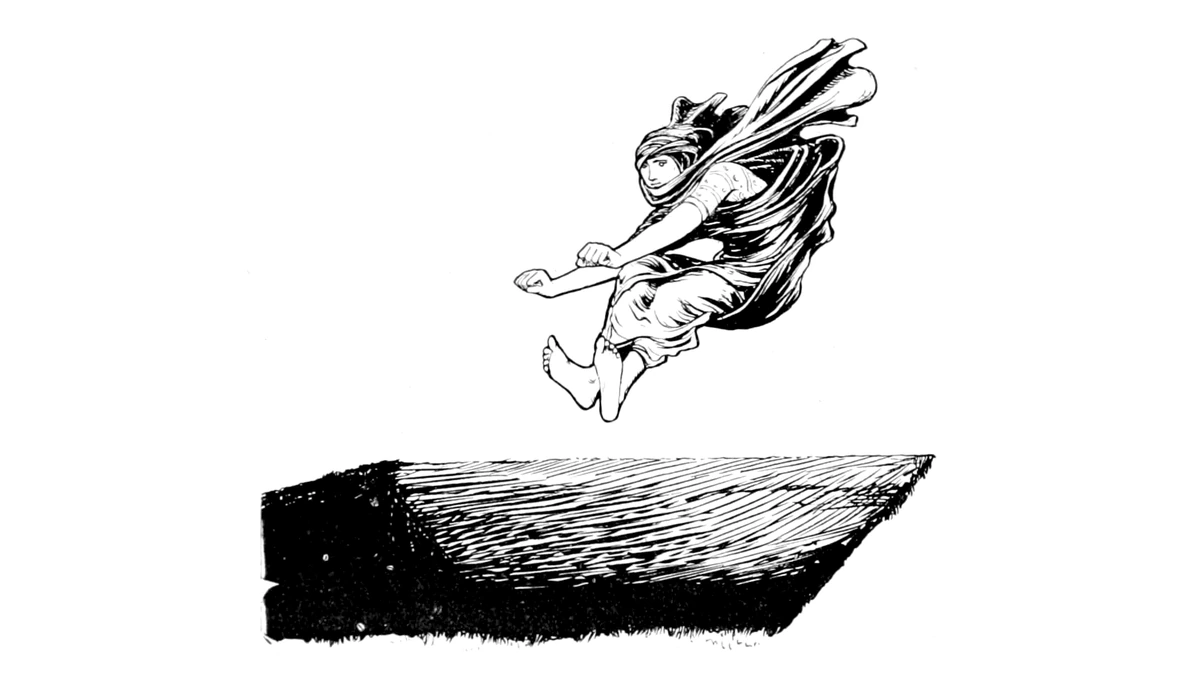
The vizier was saved. The king learned that wisdom may come from a modest farmhouse rather than a royal court. The vizier’s son and the farmer’s daughter later married, and the tale gives them a happy ending.
What Kind of Story Is Why the Fish Laughed?
This is a riddle folktale and a clever-person story. A mystery opens the plot, but the central pleasure comes from interpreting language. Each strange sentence has a practical meaning hidden beneath its surface.
Joseph Jacobs included the tale in his 1892 collection Indian Fairy Tales. His notes identify J. Hinton Knowles’s Folk-Tales of Kashmir as the source. Readers can check the free Project Gutenberg text or browse the polished Standard Ebooks edition.
The original source volume is available as an Internet Archive scan of Folk-Tales of Kashmir. A downloadable public-domain PDF scan is also available. Listeners can hear chapter 24 in the free LibriVox audiobook.
Why the Old Ending Needs Context
The final jumping test depends on an old assumption about how men and women move. That assumption is not a reliable fact. Athletic ability varies from person to person, not simply by gender.
Modern readers can treat the jump as a plot device from its period. The important discovery is that a disguised intruder has entered a trusted space. The daughter’s real achievement is recognizing a pattern of deception before anyone else does.
This makes the tale useful for discussing how retellings can preserve a story’s structure while questioning outdated ideas. Readers do not need to accept every old belief to study or enjoy a traditional tale.
Main Themes and Moral
Listen Before You Judge
The farmer assumes that the traveller is foolish because his words sound strange. His daughter listens for a second meaning. Her patience turns nonsense into useful knowledge.
Readers can compare her method with the jackal’s careful performance in The Tiger, the Brahman and the Jackal. Both characters solve danger by changing how others look at a problem.
Wisdom Is Not Limited by Rank
The king consults a powerful minister. The minister consults educated experts. Yet the answer comes from a farmer’s daughter who has no court title.
The story values observation over status. It also gives the daughter more than one clever moment. She solves the road riddles, detects the missing food, and explains the fish’s warning.
Hospitality Shows Whether a Place Is Alive
The city is crowded but cold. The cemetery is associated with death, yet its visitors share bread. The reversal asks readers to define a community by its actions.
A similar question about conduct appears in The Cruel Crane Outwitted, where promises matter less than what a character actually does.
Cleverness Should Protect People
The daughter uses intelligence to expose theft, solve danger, and save an innocent person. Her cleverness is practical and responsible.
For another Indian animal tale about thinking under pressure, read The Monkey and the Crocodile.
Why the Fish Laughed Story Questions and Answers
1. What question made the fish laugh?
The queen asked whether the fish was male or female. The unexpected laughter created the mystery that drives the story.
2. Why was the vizier in danger?
The king ordered him to explain the fish’s laughter within six months. He threatened to execute the vizier if he failed.
3. What did “carry each other” mean?
It meant that the two travellers should take turns telling stories. Conversation would make the tiring journey feel shorter.
4. How could a standing crop already be eaten?
If the farmer who owned it had debts, the harvest would already belong to creditors. Its value was gone before anyone cut it.
5. What were the two horses made with a knife?
They were two strong walking sticks cut from branches. The sticks would support the travellers like simple horses for the road.
6. Why did the traveller call the city a cemetery?
The city was full of people, but nobody welcomed the travellers. Its lack of human warmth made it seem lifeless.
7. How did the daughter detect the servant’s dishonesty?
The traveller’s coded reply described an incomplete moon, an eleven-month year, and a sea that was not full. She understood that some chapatis, ghee, and milk were missing.
8. Why did the fish laugh in the tale?
Its laughter pointed to deception inside the palace. A disguised intruder was hidden among people the queen believed she knew.
9. What is the main moral?
Do not judge words or people too quickly. Careful listening, practical reasoning, and attention to small clues can reveal the truth.
10. Who is the wisest character?
The farmer’s daughter is the strongest answer. She interprets every riddle and uses her insight to save the vizier and warn the palace.
Vocabulary From the Story
- Vizier: a senior minister or adviser to a ruler.
- Creditor: a person or group to whom money is owed.
- Hospitality: the friendly welcome and care given to guests.
- Disguise: clothing or appearance used to hide identity.
- Interpret: to explain the meaning of words, actions, or signs.
Classroom and Family Activities
- Match each riddle: Write the five road riddles on cards and pair each one with its practical meaning.
- Retell from another view: Describe the opening through the fisherwoman’s eyes.
- Update the final test: Invent a fair, evidence-based way to identify the intruder without relying on gender.
- Discuss hospitality: Decide why the tale calls one place dead and another alive.
- Create coded messages: Use ordinary objects to send a harmless message, then explain the code.
Readers who enjoy source-based folktales with discussion prompts may continue with Hunting the Stag Lapalang.
A Final Thought
The Why the Fish Laughed story begins with an impossible sound. Its real subject, however, is the difference between hearing and understanding.
The farmer hears foolish questions. His daughter hears clues. The court sees a fish behaving strangely. She sees a warning about deception.
That is why her wisdom matters. She does not merely know more than other people. She looks again when everyone else has already decided what something means.