
The Hunting the Stag Lapalang story with questions and answers introduces a moving Khasi folktale about freedom, warning, loss, and a mother’s devotion. This fresh retelling follows the main events recorded in Folk-Tales of the Khasis. It also gives young readers a clear summary, vocabulary, discussion prompts, and classroom activities.
The English collection was published by Macmillan in 1920 under the name Mrs. Rafy. Its foreword is signed with the initials K. U. R. The book presents “Hunting the Stag Lapalang” as a tale told by Khasi youths and cowherds on the hillsides.[1] This page retells that historical version in new, simple language. No translator is named in the digitised edition.
Hunting the Stag Lapalang Story
The Young Stag Wants a Wider World
Long ago, a mother deer lived with her young stag in a forest on the Plains of Sylhet. She loved him deeply and watched over him every day. She knew the safe paths, the hidden streams, and the places where danger waited.
The young deer was called Lapalang. As he grew, he became strong, graceful, and proud. His antlers rose above the ferns. His swift feet carried him through the forest with ease. Every familiar trail began to seem too short for him.
Lapalang often looked toward the Khasi Hills. Clouds moved across their green slopes, and cool winds came down from their heights. He imagined open spaces, new plants, and adventures that would test his speed.
“Stay near our forest,” his mother warned. “The hills are beautiful, but people hunt there. Strength cannot protect you from every danger.”
Lapalang heard her words, yet he believed she worried too much. He had escaped thorns, crossed swollen streams, and outrun every animal that chased him. He wanted to discover what lay beyond the forest.
One morning, he told his mother that he would climb the hills to find tender begonia leaves. She begged him to remain. He lifted his head, stepped into the morning light, and continued toward the distant ridges.

Freedom in the Khasi Hills
At first, the journey seemed to prove Lapalang right. The air grew cooler as he climbed. Mist drifted among the slopes. He found soft grass and plenty of begonia leaves beneath the trees.
He ran across the high ground simply because he could. He leaped over stones, listened to unfamiliar birds, and drank from clear hill streams. No narrow forest path held him back.
For several days, Lapalang enjoyed the new country. His mother’s warning felt far away. The hills appeared peaceful, and he saw no reason to be afraid.
Then some village boys noticed him. They had never seen such a fine stag. They called to others, and the alarm passed quickly from one settlement to the next.
The Hunt Crosses Hill and Valley
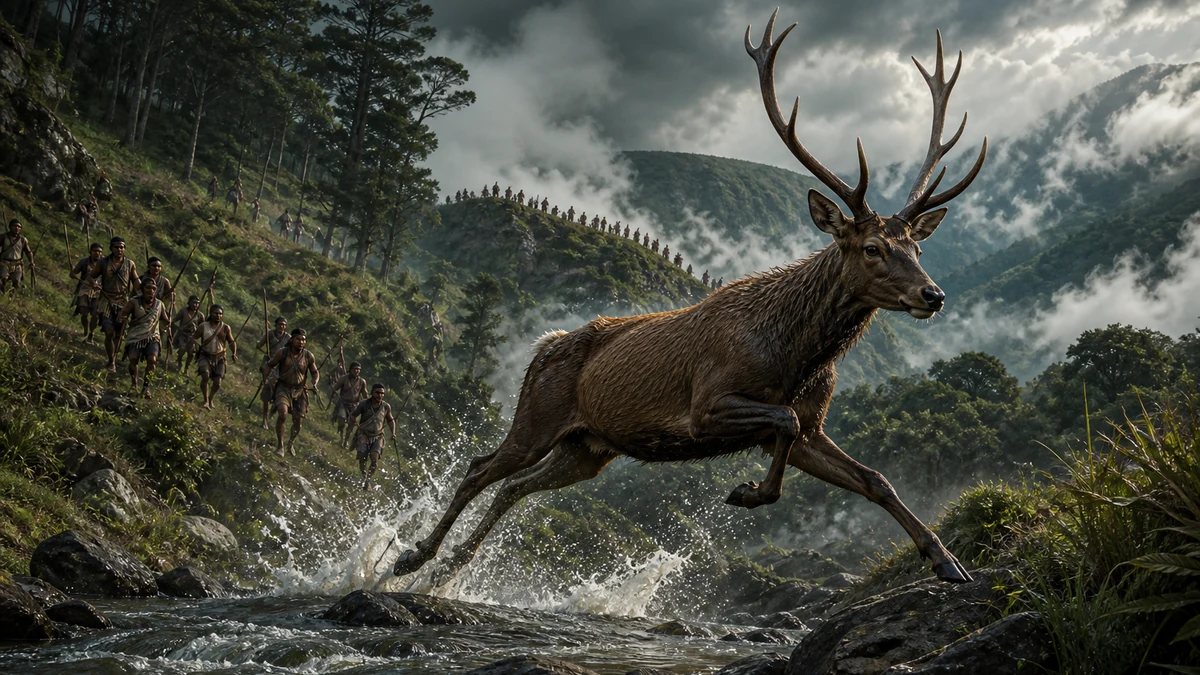
Men left their work and hurried toward the hills. Some carried bows and arrows. Others brought spears, staves, or swords. The hunting call travelled from ridge to ridge.
Lapalang heard the voices and ran. At first, his speed kept him well ahead. He crossed valleys, climbed steep paths, and disappeared into drifting cloud. Each time the hunters thought they had surrounded him, he found another opening.
The chase continued for days in the older account. Lapalang was young and powerful, but he was alone. More hunters arrived from villages and hamlets. They watched the paths and closed the spaces through which he might escape.
On the slopes of Shillong, the exhausted stag found hunters on every side. He fought desperately for his life, but an unarmed animal could not overcome so many armed pursuers. Lapalang fell on the mountain he had longed to explore.
This part of the tale may be upsetting for young listeners. A parent or teacher can say simply that the hunters caught Lapalang and that he did not return home. The story’s deepest moment comes from what happens next.
A Mother Follows the Hunting Cry
On the Plains of Sylhet, Lapalang’s mother waited. One day passed, then another. She listened for his feet among the leaves, but the forest remained quiet.
At last, she heard the distant hunting cry echoing from the hills. Fear overcame her. She left her safe home and followed the sound toward the country from which she had warned her son.
The journey was rough, yet she continued. When she reached the Khasi Hills, she learned that Lapalang had died on the slopes of Shillong. Her worst fear had become true.
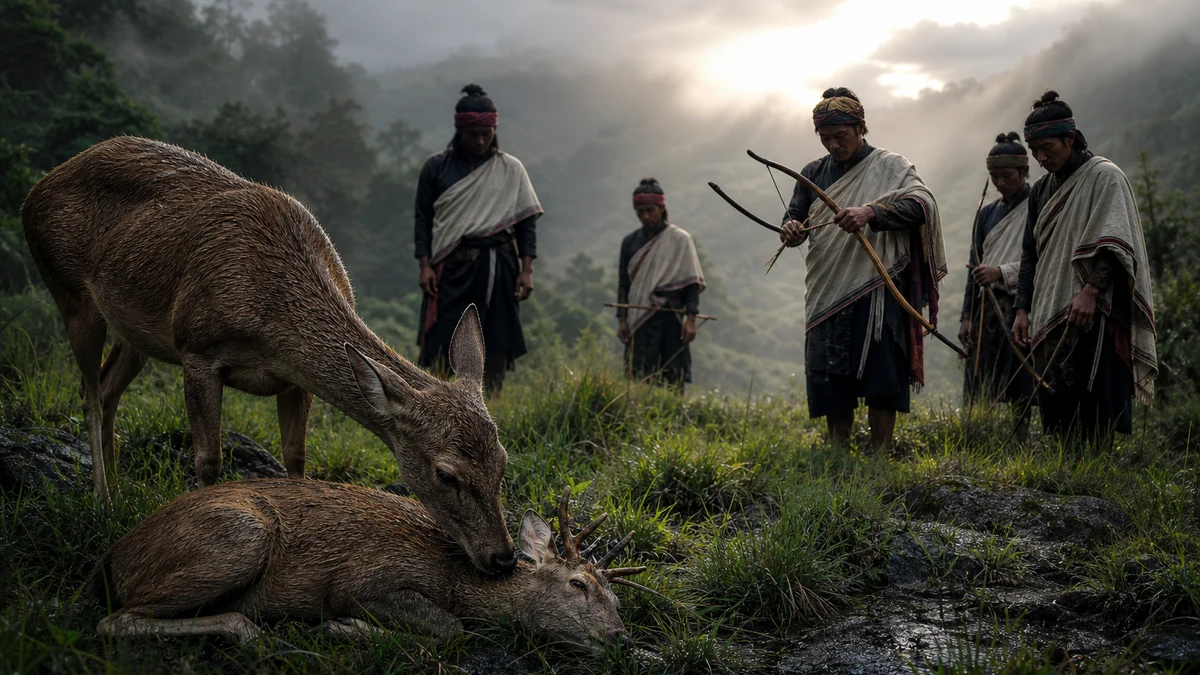
The mother deer searched the wild paths for him. Her cries travelled across the country. Families heard her sorrow. Children hid their faces, workers stopped in the fields, and the hunters lowered their weapons.
When the huntsmen heard her lament, their triumph vanished. The 1920 telling says they broke their arrows. The chase that had excited an entire countryside now looked different beside a grieving mother.
The collector connects the mother’s lament with forms of mourning attributed to the old Khasi tradition.[1] This explanation comes from a historical English collection. It is the collector’s account, not a complete description of present-day Khasi practice.
What Is the Main Idea of Hunting the Stag Lapalang?
The main idea is that freedom and courage need judgment, while love can reveal the true cost of careless action. Lapalang’s wish to explore is understandable. His mistake is believing that speed and strength make every warning unnecessary.
The hunters also change in the final scene. During the chase, they move as an excited crowd. After hearing the mother, they see the stag as someone’s beloved child. Her grief breaks the excitement that had hidden the consequence of their actions.
Is the Story Only About Disobedience?
No. “Children should obey” is one possible lesson, but it is too narrow. Lapalang grows because he wants independence. That desire is natural. The tale asks what happens when confidence ignores experience, and when a crowd forgets compassion.
The mother cannot keep her son beside her forever. Lapalang must make choices. The tragedy comes because he treats her knowledge as fear rather than useful evidence.
Why Do the Hunters Break Their Arrows?
The broken arrows show a sudden change of understanding. The hunters cannot undo Lapalang’s death. They can stop celebrating and recognise the mother’s pain. The gesture turns a successful hunt into a moment of regret.
Hunting the Stag Lapalang Summary in 70 Words
A proud young stag leaves his mother on the Plains of Sylhet to explore the Khasi Hills. He enjoys cool grass and begonia leaves until village boys raise an alarm. Hunters chase him across hills and valleys, finally surrounding him near Shillong. His mother follows the hunting cries and discovers his death. Her powerful lament moves everyone who hears it, and the hunters break their arrows in remorse.
Characters in the Story
- Lapalang: A strong young stag who longs for freedom and trusts his speed too much.
- Lapalang’s mother: A loving, experienced deer who warns him and later searches for him.
- The village boys: The first people to see the stag and raise the alarm.
- The hunters: A growing crowd that pursues Lapalang, then falls silent before his mother’s grief.
Vocabulary for Young Readers
- Stag: An adult male deer.
- Dam: A word used for the mother of an animal.
- Mettle: A person’s or animal’s courage and ability in a difficult situation.
- Begonia: A plant with soft leaves and colourful flowers.
- Crag: A steep, rough part of a rock or hill.
- Pursuit: The act of following someone or something to catch it.
- Lament: Words or sounds that express deep grief.
- Remorse: Painful regret after recognising that one has done wrong.
Hunting the Stag Lapalang Questions and Answers
1. Where did Lapalang live with his mother?
They lived in a forest on the Plains of Sylhet, below the Khasi Hills.
2. Why did Lapalang want to leave?
He felt limited by his familiar forest. He wanted to explore the hills, test his strength, and eat begonia leaves.
3. What warning did his mother give?
She warned that the hills held dangers, especially hunters. She asked him to remain near their forest home.
4. What did Lapalang find in the hills?
He found cool heights, tender leaves, good grass, clear streams, and the freedom he had imagined.
5. How did the hunt begin?
Village boys saw the unusual stag and raised an alarm. Men then came from surrounding villages and hamlets.
6. Why could Lapalang not escape forever?
He was swift and strong, but he was one tired, unarmed animal. The number of armed hunters kept growing.
7. How did Lapalang’s mother learn something was wrong?
He did not return, and she heard the hunting cry echoing from the distant hills. She followed it in fear.
8. What effect did her lament have?
People stopped what they were doing. The hunters lost their sense of triumph and broke their arrows.
9. What does the broken arrow symbolise?
It symbolises regret and a refusal to continue celebrating the harm that the hunters have finally understood.
10. What is one balanced lesson from the tale?
Independence is valuable, but courage should listen to experience. A confident choice still needs careful attention to real danger.
Classroom and Family Activities
Warning or Worry?
List each warning from Lapalang’s mother. Ask readers which warning is supported by evidence and which parts show her love. Discuss how a warning can be both emotional and sensible.
Map the Journey
Draw a simple route from the Plains of Sylhet to the Khasi Hills and Shillong. Mark the forest home, the begonia leaves, the chase, and the final search. Label it as a story map rather than an exact historical route.
Change the Point of View
Retell one short scene from the viewpoint of a village child who sees the stag. Then rewrite it after the child hears the mother. Compare how new knowledge changes the same event.
Read a Contrasting Animal Tale
Compare Lapalang’s tragic confidence with the crab’s careful observation in The Cruel Crane Outwitted. Readers can also compare quick thinking in The Monkey and the Crocodile and The Tiger, the Brahman and the Jackal.
For a different Asian folktale about risk, art, and courage, continue with The Boy Who Drew Cats story with questions.
Source, Free Edition, and Historical Scan
This retelling uses the chapter “Hunting the Stag Lapalang” in the 1920 book Folk-Tales of the Khasis. Project Gutenberg identifies the author as Mrs. Rafy. It marks the ebook as public domain in the United States.[2] The Internet Archive records the same 1920 Macmillan edition. It also provides a scan of the printed book.[3]
- Read the original chapter on Project Gutenberg.[1]
- Download the free EPUB or plain-text edition.[2]
- Open the 1920 edition as a scanned PDF.[3]
The old text contains intense hunting imagery. This version shortens that scene while preserving the tale’s central movement from confidence to grief and compassion.