
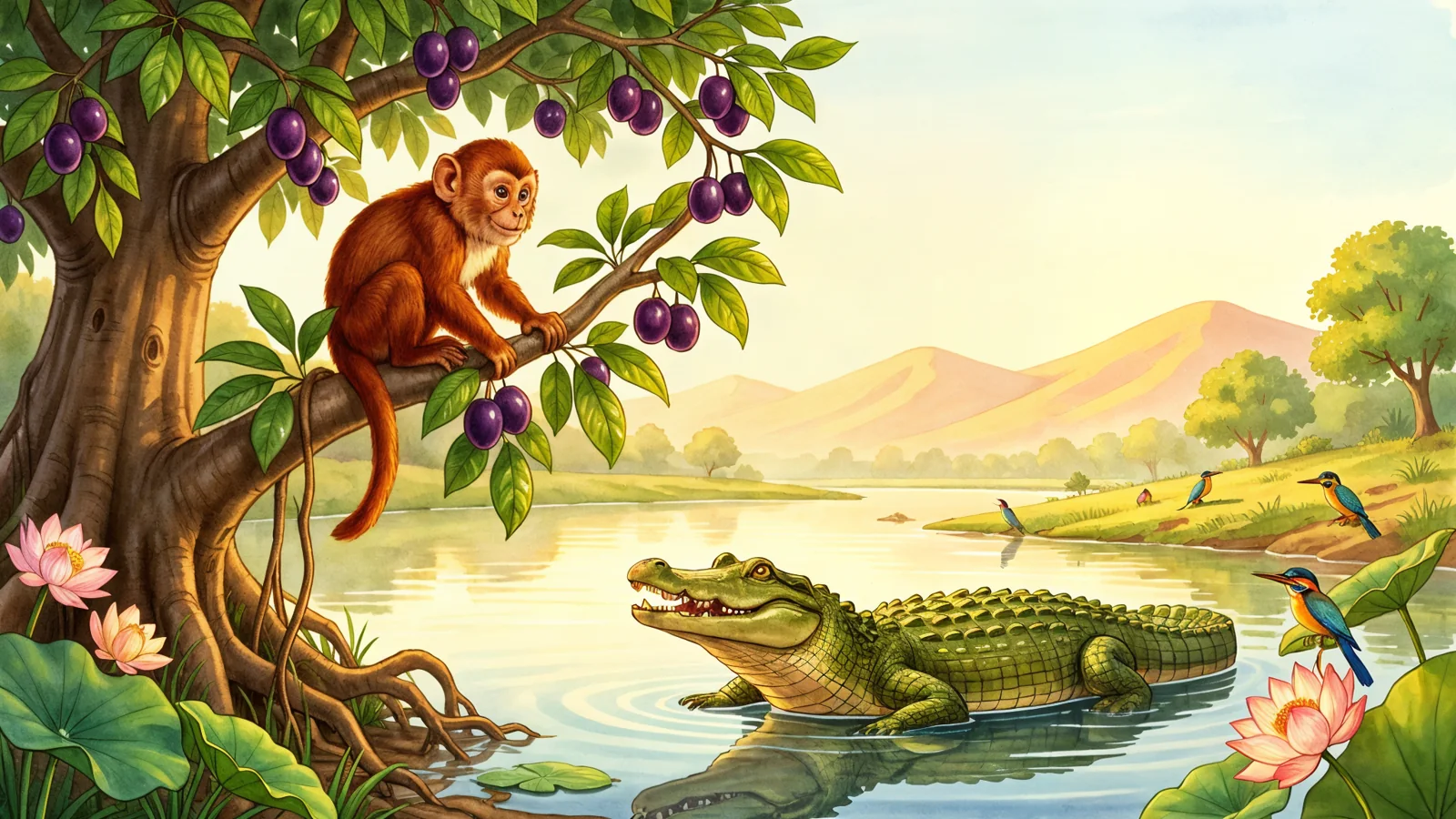
A clever monkey, a lonely crocodile and a handful of ripe purple fruit begin this long moral story for kids beside a warm Indian river. Their friendship grows through small acts of kindness, but greed and a terrible lie soon put that friendship to the test.
This original retelling of a beloved Panchatantra tale is made for family reading. It offers gentle suspense, lively dialogue and a clear lesson about trust, courage and thinking before we act.
A Long Moral Story for Kids About Trust and Quick Thinking
The Jamun Tree Beside the River
Long ago, on the green bank of a wide river in India, there grew an old jamun tree. Its roots gripped the dark soil like strong brown fingers. Its branches stretched over the water, offering shade to fish, turtles and anyone who rested below.
In the hot months, the tree was heavy with jamuns. Some were pink and sharp with sourness. Others had ripened to such a deep purple that they looked almost black. When the breeze shook the leaves, the ripe fruit dropped with soft plops into the river.
A monkey lived in that tree.
He had bright eyes, quick hands and a tail that curled behind him whenever he was pleased. He knew every branch, from the broad limb where he slept to the thin upper twigs where the sweetest fruit hid among glossy leaves.
The tree gave him shelter from summer heat and monsoon rain. It gave him food each morning. Still, his days were often quiet.
Parakeets visited in noisy green flocks, but they soon flew away. A kingfisher flashed blue above the water, never staying long enough for a conversation. The monkey could chatter to himself, yet even a cheerful creature sometimes wished for a friend.
One blazing afternoon, the river shone like hammered silver. The monkey sat in a patch of shade, eating jamuns and watching dragonflies skim the surface.
Then he saw two eyes rising from the water.
A long, rough head followed. With a slow sweep of his tail, a crocodile glided toward the bank and settled beneath the tree.
The monkey scrambled to a higher branch.
“Why have you come here?” he called. “If you are looking for lunch, you will have to search somewhere else.”
The crocodile lifted his snout. “I am looking for shade, not lunch. I have been swimming since sunrise, and the sun has baked my back.”
“You have many teeth for someone who only wants shade.”
“And you have many questions for someone who is safely in a tree.”
The monkey stared at him. The crocodile stared back. Then, to the monkey’s surprise, the crocodile gave a tired chuckle.
The monkey relaxed a little.
“You do look weary,” he said. “Have you eaten?”
“Not since yesterday.”
The monkey picked three of the ripest jamuns. “Open your mouth.”
The crocodile opened it wide.
“Not that wide!” cried the monkey. “You could frighten the clouds.”
He tossed down a fruit. It landed on the crocodile’s nose, rolled once and dropped neatly between his jaws.
The crocodile bit into it. Sweet juice spread across his tongue.
“That is wonderful,” he said. “It tastes of rain and sunshine together.”
The monkey laughed and tossed down more.
A Friendship Grows
The crocodile returned the next afternoon. This time, the monkey did not climb quite so high.
“I thought you might have forgotten the way,” the monkey said.
“I followed the purple stains on the riverbank.”
The monkey showered him with jamuns. While the crocodile ate, they talked.
The monkey told him which birds built the messiest nests and how the first monsoon wind made every leaf turn its pale underside toward the sky. The crocodile described deep pools where silver fish moved in circles and quiet sandbars warmed by the morning sun.
Day after day, the crocodile came back.
Soon the monkey waited for the familiar ripple that appeared before his friend’s head broke the surface. He saved a small heap of choice fruit on a broad branch. The crocodile sometimes brought news from farther down the river, where washermen beat clothes against flat stones and children floated little leaf boats along the edge.
They were different in almost every way. One slept among leaves, the other near the muddy shore. One leaped from branch to branch, the other moved with patient strokes beneath the water. Yet both knew what it was to be alone, and both were glad of company.
One evening, clouds gathered in soft grey towers. The monkey noticed that the crocodile was looking at the remaining jamuns.
“Still hungry?” he asked.
“I was thinking of my wife,” said the crocodile. “She lives with me on the far bank. I have told her about this tree and about you, but she has never tasted its fruit.”
“Then take her some.”
The monkey pulled a large leaf into the shape of a bowl. He filled it with ripe jamuns and tied it with a long blade of grass.
“Carry this above the water,” he warned. “Jamuns are fine swimmers when they fall, but they are not good at finding their way home.”
The crocodile balanced the leaf bundle on his head and swam away.
His wife was delighted by the gift. The fruit was fragrant and sweet, and its juice coloured her tongue purple.
“Your friend sent these?” she asked.
“Yes,” said the crocodile. “He gathers them fresh from the branches.”
“Bring more tomorrow.”
So he did.
At first, the crocodile’s wife listened with interest when he spoke about the monkey. Then his stories began to bother her.
Every evening, it seemed, her husband had another reason to praise his new friend.
“The monkey made me laugh today.”
“The monkey knows when rain is coming.”
“The monkey saved the sweetest fruit for us.”
His wife tasted the jamuns, but her pleasure soured into jealousy. She began to resent the hours her husband spent beneath the tree. She imagined the monkey laughing at her from across the water, though he had never spoken an unkind word about her.
A cruel thought entered her mind.
The Crocodile’s Wife Makes a Demand
One morning, the crocodile found his wife lying still beside the reeds.
“What is wrong?” he asked.
“I am ill,” she murmured.
He touched her gently with his snout. “Tell me what will help you.”
She closed her eyes. “Nothing you can bring.”
“I can search the whole river. Do you need a certain root? A healing leaf? Fresh fish from the deepest pool?”
“No.” She paused, then said, “Only the heart of the monkey who eats those sweet jamuns can cure me.”
The crocodile drew back in horror.
“The monkey is my friend.”
“Then you care more for him than you do for me.”
“That is not true. But he welcomed me when I was tired. He fed me. He sends fruit to our home.”
His wife turned her face away. “If you refuse, I will surely die.”
The crocodile did not believe that jamuns could make a heart sweet, nor that such a heart could cure an illness. He suspected that jealousy, not sickness, lay behind her demand. But she wept, pleaded and accused him until his thoughts felt tangled like weeds around his feet.
For many hours he remained near the reeds.
He remembered the monkey’s laughter. He remembered the first fruit dropping onto his nose. He remembered all the peaceful afternoons under the jamun tree.
He should have refused.
Instead, he let fear and weakness overcome loyalty. At last, he lowered himself into the river and swam toward his friend.
The current pressed against him. Each stroke felt heavier than the one before.
An Invitation Across the Water
The monkey saw him coming and waved from the tree.
“You are late! I began to think a school of fish had invited you to a feast.”
The crocodile tried to smile. “My wife has invited you to one.”
The monkey blinked. “Invited me?”
“Yes. She says it is shameful that she has eaten so many of your jamuns without welcoming you to our home. She has prepared a fine meal on the far bank.”
The monkey was pleased. He had often wondered about his friend’s home, and he liked the thought of meeting the crocodile’s wife.
Then he looked down at the river.
“I cannot swim,” he said. “I can leap over a narrow stream, but this river is far too wide.”
“Ride on my back. I will keep you safe.”
The monkey hesitated.
The crocodile’s voice sounded flat, and he did not look up. Yet friends sometimes grew quiet when they were worried. Perhaps, thought the monkey, the crocodile was merely anxious about carrying a passenger.
He gathered a fresh bundle of jamuns as a gift. Then he climbed down to the lowest branch, which bent above the water.
“Come closer,” he said.
The crocodile moved beneath him.
The monkey took a breath and jumped.
For one frightening instant, there was only air and shining water. Then his hands gripped the crocodile’s rough back. He tucked the leaf bundle under one arm and wrapped his tail around himself.
“Ready?” asked the crocodile.
“Go slowly,” said the monkey. “This is the first time I have ridden a friend who floats.”
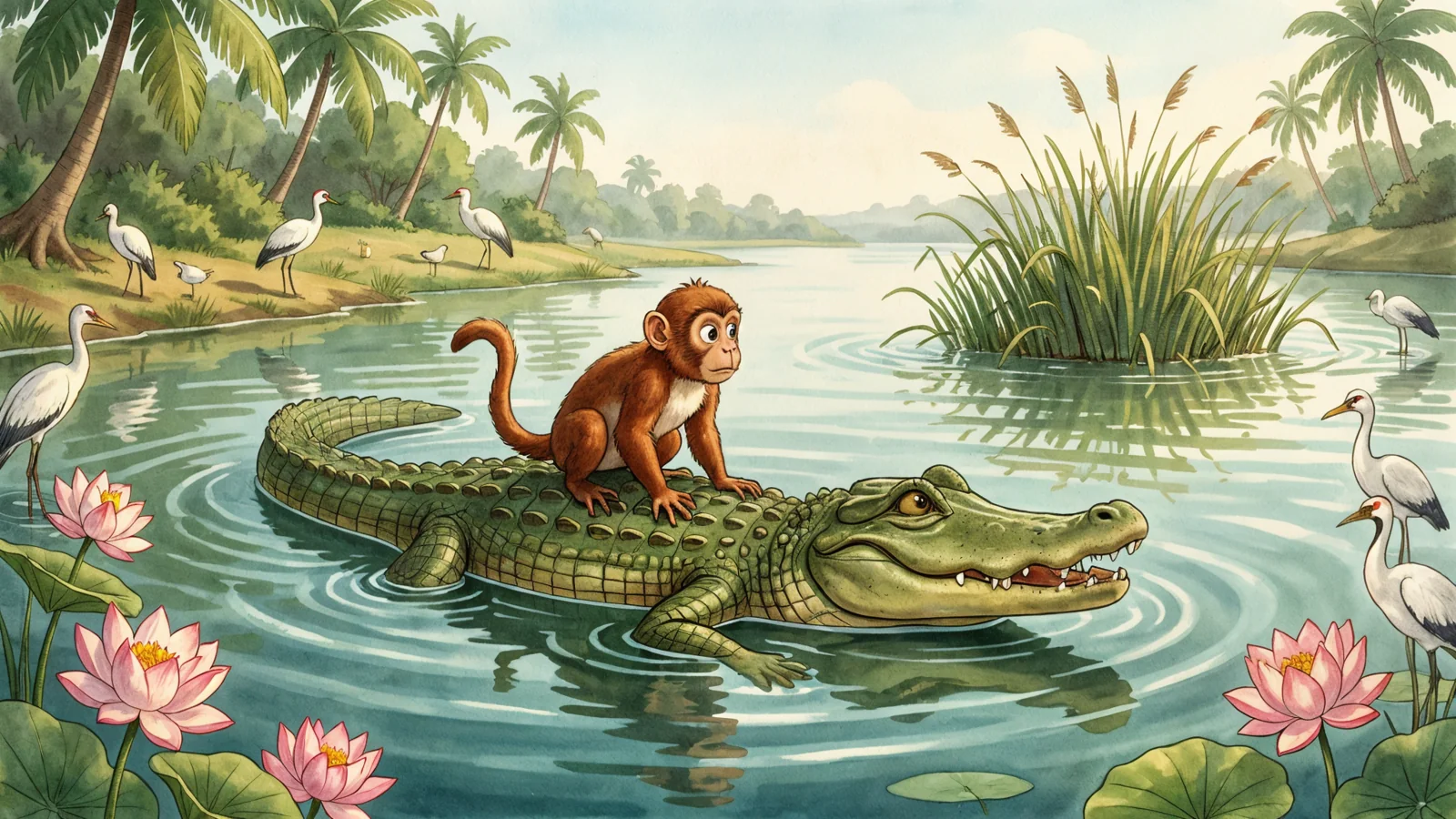
They set out.
At first, the monkey was amazed. The jamun tree seemed to shrink behind him. He saw white egrets standing among reeds and fish darting below like loose pieces of silver. Cool drops splashed his face.
But as they neared the middle, the water grew dark and deep. The current tugged hard at the crocodile’s body.
Without warning, the crocodile sank lower.
Water washed over the monkey’s feet.
“Please stay near the surface,” he cried. “I told you I cannot swim.”
The crocodile rose again, but his breathing was uneven.
The monkey leaned close. “What troubles you? You have hardly spoken since we left.”
The crocodile could no longer bear the weight of his secret.
“There is no feast,” he said.
The monkey’s fingers tightened against the rough scales.
“What do you mean?”
“My wife says she is ill. She believes only your heart can cure her. I am carrying you home so she may have it.”
The leaf bundle slipped from the monkey’s arm. Jamuns scattered across the water and drifted behind them like purple beads.
For one moment, terror emptied his mind.
The far bank was still distant. The jamun tree was far behind. Beneath him waited deep water, and beneath that water were shadows he could not see. He could not fight the crocodile. He could not outrun him.
He wanted to shout. He wanted to beg.
Instead, he took one slow breath.
Then another.
A thought came to him, small but bright.
The Monkey Remembers His Wits
The monkey sat up as calmly as he could.
“My dear friend,” he said, “why did you not tell me sooner?”
The crocodile turned his head slightly. “You are not angry?”
“Angry? Your wife is ill, and you need my heart. I would have brought it gladly.”
The crocodile slowed. “Brought it?”
“Of course. I do not carry my heart when I go visiting.”
The crocodile had never climbed a tree. He knew little about the habits of monkeys. “You do not?”
“It is too precious,” said the monkey. “I keep it in a safe hollow high in the jamun tree. When I swing through thin branches, it might be knocked about. When I sleep, I place it close to the trunk.”
The crocodile stopped swimming.
The monkey continued before his voice could tremble. “What a foolish mistake I have made. We have come all this way, and the very thing your wife needs is still in the tree.”
“Can you fetch it?”
“We must hurry. Turn around now, and I will bring it down.”
The crocodile believed him. Hope pushed aside the last of his doubt. He swung his body around and began swimming toward the jamun tree.
“Faster,” urged the monkey. “We must not keep your wife waiting.”
The crocodile drove through the current. Water foamed beside his jaws. The tree grew larger, first a green mark on the bank, then a familiar crown of branches.
The monkey watched every yard pass. His heart, which was certainly not in a hollow, hammered against his ribs.
When they reached the bank, the crocodile moved beneath the lowest branch.
The monkey sprang.
His fingers caught a twig. It bent sharply, but he swung forward, seized a stronger limb and scrambled up the trunk. He did not stop until he reached the broad branch where he usually slept.
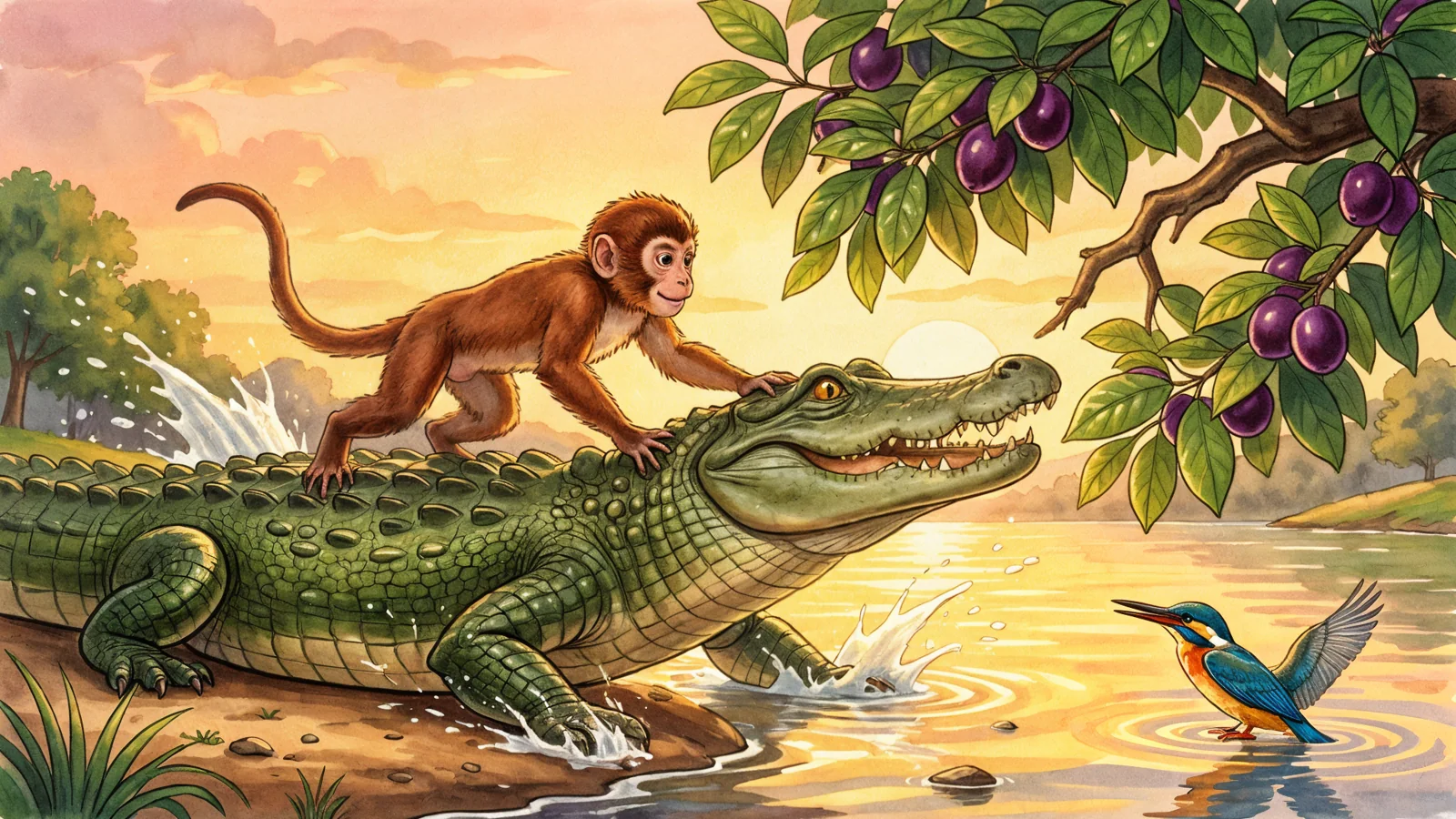
Leaves shook around him. A few jamuns fell into the water.
The crocodile waited below.
“Well?” he called. “Bring your heart. We must go.”
The monkey looked down. Relief gave way to grief, then anger.
“No creature leaves his heart hanging in a tree,” he said. “You told me you were taking me to a feast, but you meant to take my life. I spoke that foolish tale because it was my only way to escape.”
The crocodile stared at the water.
“I was wrong,” he said at last. “Please come down. I will not harm you. We can forget this and be friends again.”
The monkey shook his head.
“A cracked fruit may still smell sweet, but it cannot be made whole. You carried me into deep water after I trusted you. If I climb onto your back again, I will be a fool by choice.”
“I am sorry.”
“You should be. Your wife asked for cruelty, but you agreed to it. A friend who plans another friend’s death is no friend at all.”
The crocodile had no answer.
He remembered each bundle of fruit he had carried home. He remembered how eagerly the monkey had jumped onto his back. Shame settled over him more heavily than river mud.
The monkey’s voice softened, though he remained high in the tree.
“Go home. Tell your wife that greed has brought her nothing. Tell her my heart is where it has always been, inside me.”
The crocodile turned toward the river.
He paused once, perhaps hoping the monkey would call him back. No call came.
Slowly, he slipped into the current and swam away. The line of his back disappeared beneath the shining water.
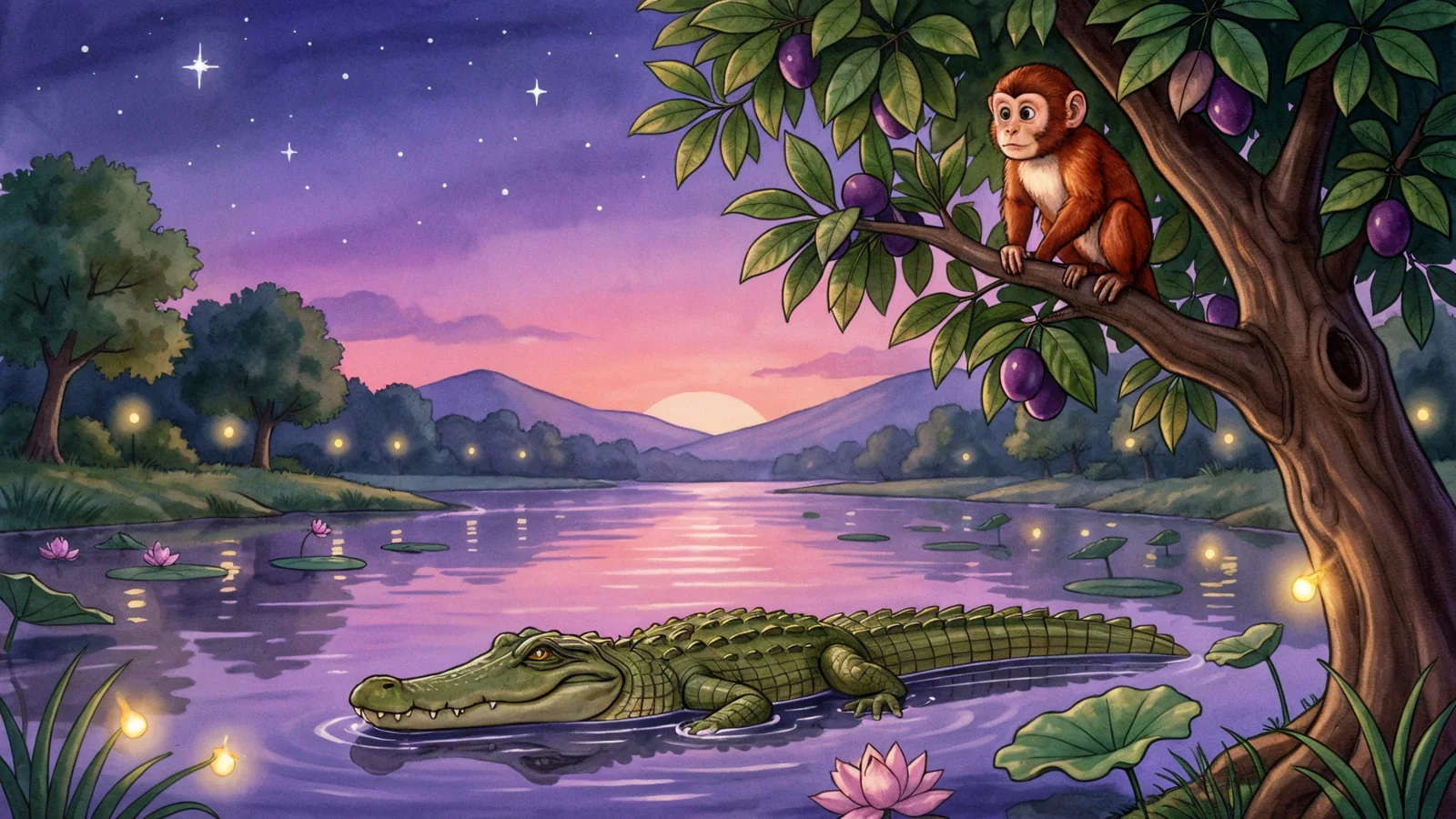
That evening, the river reflected a red sky. Parakeets quarrelled among the upper leaves, and the sweet smell of crushed jamuns rose from the bank. Everything looked much as it had before, yet the tree felt quieter.
The monkey had saved his life, but he had lost a friend he once trusted.
For several days, he felt both angry and sad. Then he understood that cleverness had rescued him, while caution would protect him in the future. He still offered fruit to hungry birds and tired travellers. He did not allow one betrayal to harden his kind heart.
But whenever anyone asked him to place his safety entirely in their hands, he watched their face, listened to their words and thought carefully before he leaped.
What Children Can Learn From the Story
Why the Monkey Escapes
The monkey cannot swim, and he is trapped in the middle of a deep river. Strength cannot help him. Panic would only make his danger worse.
His first wise act is to pause. Those two slow breaths give him enough time to notice what the crocodile does not know. The crocodile understands water, not life in the treetops. The monkey uses that gap in knowledge to invent a believable answer.
His clever reply is not a trick played for fun or reward. It is a defence against betrayal. Once he reaches the tree, he refuses to risk himself again.
What the Crocodile Does Wrong
The crocodile knows that his wife’s demand is cruel. He remembers the monkey’s kindness and understands what friendship requires. Even so, he gives in to pressure.
That choice matters. His wife suggests the betrayal, but the crocodile carries it out. He cannot place all the blame on her.
He also lies about the invitation. His lie turns the monkey’s generosity against him, because the monkey even brings fruit for the supposed meal. When the crocodile asks to be trusted again, an apology is not enough to repair the danger he created.
Kindness Still Has Value
The ending does not teach children to distrust everyone. The monkey’s kindness was real, and it brought him genuine happiness before the betrayal. His mistake was not sharing fruit. His mistake was ignoring his concern when the crocodile behaved strangely, then giving him complete control of the crossing.
Good judgement lets kindness continue without leaving the door open to harm. That balance is one reason this Panchatantra story in English still works well for family reading and classroom discussion.
The Moral of the Monkey and the Crocodile
This Indian moral story for kids offers several connected lessons:
- Stay calm in danger. A frightened mind may freeze, but a calm mind can notice a way out.
- Think before you act. The monkey saves himself by pausing before he speaks.
- Do not betray trust. The crocodile loses a true friend because he chooses fear and dishonesty over loyalty.
- Do not follow a cruel demand. Pressure from someone close to us does not make a wrong action right.
- Forgiveness does not require unsafe trust. The monkey does not seek revenge, but he also does not climb onto the crocodile’s back again.
The central moral is simple: wisdom and presence of mind can protect us when strength cannot, while trust must be supported by honest actions.
Why This Moral Story Still Matters
The monkey returns to his jamun tree with no weapon and no special power. He survives because he keeps his fear from choosing his next words. The crocodile, though stronger in the river, loses the friendship because he allows another creature’s greed to guide him.
That is what makes this tale a lasting long moral story for kids. It respects kindness without confusing kindness with carelessness. It shows that quick thinking can save us, and that someone who breaks trust must accept the consequences. Most of all, it reminds young readers that a clear mind can find hope even in a frightening moment.
Frequently Asked Questions
What age group is this story best for?
This retelling is best suited to children ages 7 to 12. Younger children may enjoy it as a read-aloud, especially if an adult pauses to explain the wife’s demand and reassure them that the monkey escapes safely. Older children can discuss betrayal, pressure and the difference between accepting an apology and restoring trust.
What is the main lesson of The Monkey and the Crocodile?
The main lesson is that calm thinking can overcome danger, while dishonesty destroys friendship. It also helps children see that they can reject an unsafe request even when it comes from someone they know. The crocodile’s regret does not require the monkey to place himself at risk again.
Is the story too frightening for children?
The threat is serious, but the story avoids graphic detail, and the monkey escapes unharmed through wit. Parents can frame the tense river scene as a chance to notice the monkey’s self-control. If a child is sensitive, pause after the crocodile reveals the plan and ask what clever answer the monkey might give.
How can parents or teachers use this story after reading?
Ask children to name the moment when each character could have made a better choice. They can also act out the friendly scenes, draw the jamun tree or write a new apology from the crocodile. The illustrations can help younger readers retell each major scene in their own words.
About This Panchatantra Retelling
This is an original English retelling of “The Monkey and the Crocodile,” a traditional tale found in the ancient Indian Panchatantra and related Jataka traditions. The plot belongs to a centuries-old storytelling tradition, while the wording, dialogue, descriptions and illustrations on this page were created for Online Story Hub.