
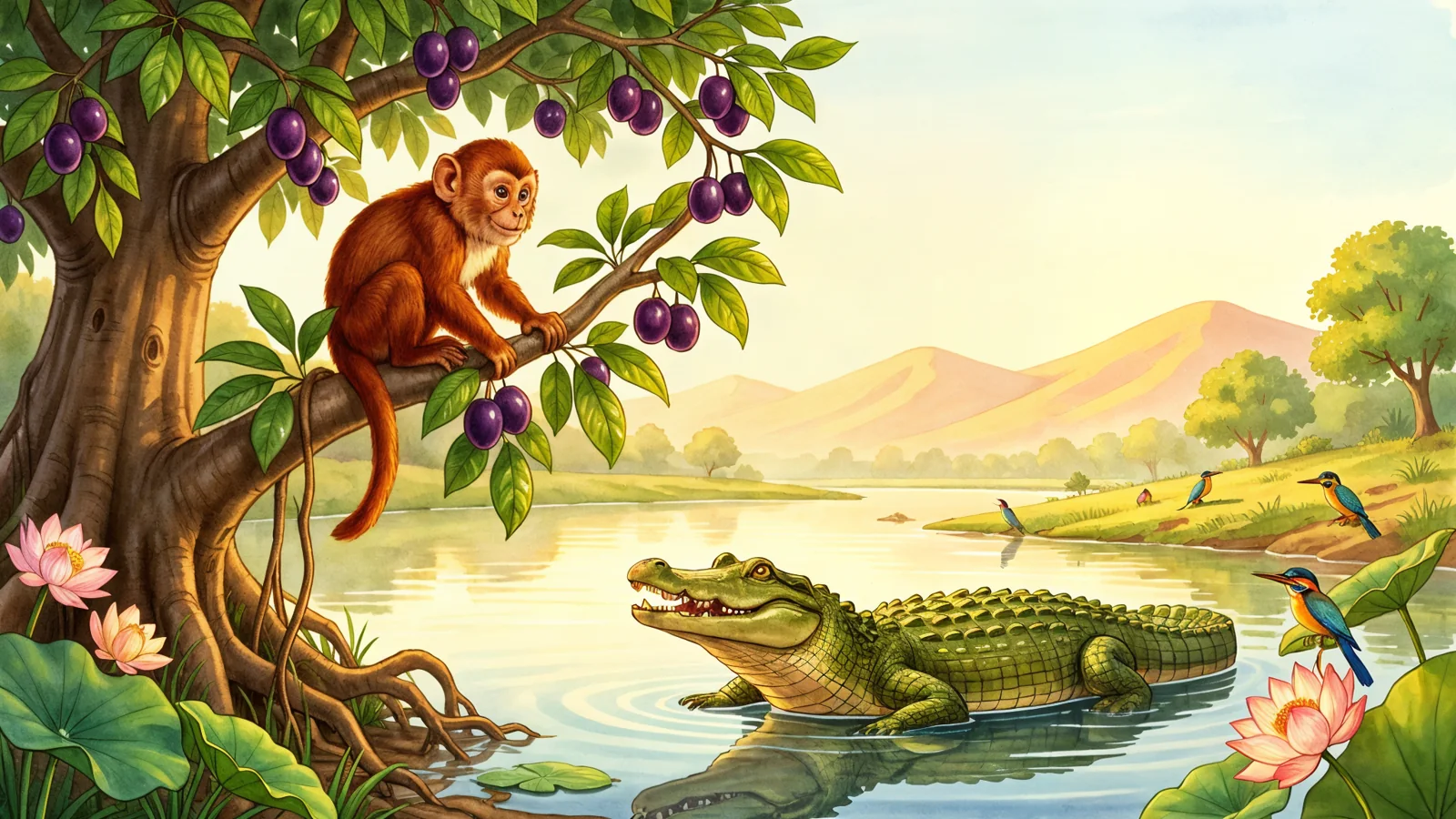
AI-generated illustration.
Moral stories for kids have been told for thousands of years to teach children about life, friendship, and wisdom. The tale of the Monkey and the Crocodile is one of the most beloved Panchatantra stories, originating from ancient Indian folklore.
This moral story for children tells of a clever monkey who lives in a jamun tree beside a river. A lonely crocodile becomes his friend, and together they share sweet fruit and happy afternoons. But when the crocodile’s wife demands the monkey’s heart, the clever monkey must use his wits to escape danger.
Perfect for children ages 7-12, this story teaches about trust, betrayal, and the power of quick thinking — lessons similar to those in Mahabharata stories for kids.
The Jamun Tree by the River
A Friend in Need
On the green bank of a wide river in India, there grew an old jamun tree. Its branches stretched over the water, heavy with sweet purple fruit. In this tree lived a clever monkey with bright eyes and a curious mind.
One hot afternoon, the monkey was enjoying his jamuns when he noticed a crocodile swimming slowly toward the bank. The crocodile looked tired and lonely.
“Why so sad?” asked the monkey.
“I have no friends,” replied the crocodile. “The river is wide, and I swim alone.”
The monkey felt sorry for the crocodile. “Would you like some jamuns? They are the sweetest in the whole forest.”
He tossed down a ripe fruit, and the crocodile ate it with delight. From that day on, the crocodile visited every afternoon, and the monkey shared his fruit.
A Growing Friendship
Day after day, the crocodile came back. They talked about the river, the forest, and the wonderful jamun tree. The monkey told stories about the birds and the monkeys. The crocodile described deep pools and sandy banks.
Soon, the monkey saved the best jamuns for his friend. The crocodile brought news from far downstream, where washermen beat clothes against stones and children floated leaf boats.
One evening, the crocodile said, “My wife has never tasted these wonderful fruits. May I bring her some?”
“Of course!” said the monkey. He filled a large leaf with the choicest jamuns and tied it with a blade of grass.
The crocodile’s wife was delighted. The fruit was sweet and fragrant, and she asked her husband to bring more the next day.
And so he did, every day, until his wife grew curious about the monkey himself.
A Dangerous Request
One morning, the crocodile’s wife fell ill. “I need the heart of the monkey who eats such sweet fruit,” she whispered. “Only his heart can cure me.”
The crocodile was horrified. “He is my friend! I cannot betray him!”
“Then you love him more than me,” she cried, pretending to be worse.
Trapped between his wife’s demands and his friendship, the crocodile made a terrible choice. He swam to the jamun tree with a heavy heart.
“My wife invites you to dinner,” he said. “Please come to our home on the far bank.”
The monkey was pleased. “But I cannot swim!”
“Ride on my back,” said the crocodile. “I will keep you safe.”
The monkey hesitated, but trusted his friend. He gathered a final bundle of jamuns as a gift and jumped onto the crocodile’s back.
The Crisis on the River
The Truth Revealed
Halfway across the river, the crocodile sank lower. The water washed over the monkey’s feet.
“What is wrong?” cried the monkey.
The crocodile could bear his secret no longer. “There is no dinner,” he confessed. “My wife is ill, and she believes only your heart can cure her. I am taking you to her.”
The monkey’s heart raced with fear. He was trapped in the middle of the river, with deep water beneath and a powerful crocodile beneath him. He could not swim. He could not fight.
But then, something clever happened.
The monkey sat up as calmly as he could. “My dear friend,” he said, “why did you not tell me sooner?”
The crocodile turned in surprise. “You are not angry?”
“Angry? Of course not! I would have brought my heart gladly. But I do not carry it with me when I visit.”
The crocodile stared. “You do not?”
“No,” said the monkey. “I keep it safe in a hollow in our jamun tree. It is too precious to carry around. When I sleep, I place it close to the trunk.”
The crocodile stopped swimming. “Can you fetch it?”
“We must hurry!” said the monkey. “Turn around now, and I will bring it down.”
A Clever Escape
The crocodile believed him. Hope pushed aside his doubt, and he turned back toward the jamun tree.
“Faster!” urged the monkey. “We must not keep your wife waiting!”
The crocodile swam as fast as he could. When they reached the bank, the monkey sprang into the air, caught a low branch, and scrambled up the trunk.
He did not stop until he reached the safety of his treetop home.
“Thank you for the ride,” the monkey called down. “But I cannot come down. You promised friendship, but you brought me here to harm me. A friend who betrays trust is no friend at all.”
The crocodile was filled with shame. “I am sorry,” he said. “Please come down. We can be friends again.”
“A cracked fruit may still smell sweet,” replied the monkey, “but it cannot be made whole again. Go home and tell your wife that greed has brought her nothing.”
The crocodile swam away, his head bowed in regret. The monkey stayed in his tree, wiser but sorrowful. He had escaped danger through quick thinking, but he had lost a friend through betrayal.
What This Moral Story Teaches Children
This Panchatantra moral story for kids offers several important lessons:
- Stay calm in danger. A frightened mind freezes, but a calm mind finds solutions.
- Think before you act. The monkey saves himself by pausing before responding.
- Do not betray trust. The crocodile loses a true friend by choosing fear over loyalty.
- Do not follow cruel demands. Pressure from someone close does not make wrong actions right.
- Forgiveness does not require unsafe trust. The monkey does not seek revenge, but he also does not risk himself again.
Why Moral Stories Matter
Moral stories for kids like the Monkey and the Crocodile help children:
- Understand the difference between right and wrong
- Learn about consequences of actions
- Develop critical thinking skills
- Appreciate the value of true friendship
- Build empathy and emotional intelligence
Frequently Asked Questions
What age is this moral story for?
This story is suitable for children ages 7-12. Younger children may enjoy it as a read-aloud with parental guidance, while older children can discuss the deeper themes of trust and betrayal.
What is the main moral of this story?
The main moral is that clever thinking can overcome danger, while dishonesty destroys friendship. Quick wit saves the monkey, but the crocodile’s betrayal costs him a true friend.
Is this story too scary for children?
The danger is real but handled gently. The monkey escapes unharmed through wit, and the story avoids graphic details. Parents can discuss the tension as a chance to talk about self-control and smart decisions.
What is the Panchatantra?
The Panchatantra is an ancient Indian collection of fables dating back over 2,000 years. These stories teach wisdom through animal characters and have been translated into many languages worldwide.
Read More Moral Stories
Enjoyed this moral story for kids? Explore more:
- The Honest Woodcutter
- Yudhishthira and the Dog
- Moral Stories for Kids
- Folk Stories for Kids
- Indian Folk Stories
About This Story
This moral story for kids is an original English retelling of “The Monkey and the Crocodile,” a traditional tale from the ancient Panchatantra. The plot belongs to a centuries-old storytelling tradition, while the wording and illustrations were created for Online Story Hub.
AI illustration disclosure: The illustrations for this article may be created with the help of AI. They are original visual interpretations made for Online Story Hub and are not copied from any protected studio style.